A Chinese charger plugged into a US outlet does one of two things, and the label on the brick tells you which. If it reads 100-240V and 50/60Hz, you need a small plug adapter and nothing else. If it reads 220V only, that adapter will do nothing useful.
The distinction matters because adapters get sold as if they solve everything. They do not. A plug adapter changes the shape of the pins. It changes nothing about the electricity.
So the question reduces to two numbers. Voltage, and frequency. Get those right and the rest is a hardware store errand.
Voltage: what half the power actually means
The United States runs on 120 volts at 60 hertz. China runs on 220 volts at 50 hertz. That is the entire starting point.
For electronics, the difference was solved by the manufacturer already. Phone chargers, laptop bricks, routers, TV boxes and most small gadgets ship with switching power supplies rated 100-240V and 50/60Hz.
Those devices do not care which country they are in. A 220V switching supply on 120V draws what it needs and produces the same output.
Appliances are the other category. A Chinese electric kettle is built for 220V. It exists to make heat. That is where the arithmetic turns ugly.
Power scales with the square of voltage. Run a 220V heating element at 120V and you get roughly 30% of its rated output.
A 1,500 watt Chinese kettle becomes a 450 watt kettle. Same story for a rice cooker.
My judgment: buy those in the US. A transformer that can carry a 1,500 watt heating load costs more than the appliance, weighs more than the appliance, and turns a countertop device into a floor project.
Motor-driven appliances are a separate problem, and this one is sneaky. A 50Hz motor running on 60Hz spins about 20% faster. A turntable plays sharp. A clock runs fast. A fan pushes more air than it was designed to move.
No transformer fixes that, because a transformer changes voltage and not frequency.
Then there is the hazard sitting quietly next to all of this. Devices with heating elements are the ones that need a real ground and most often get a plastic adapter instead. A two-prong adapter defeats the ground pin on a metal-bodied appliance.
I would not run a metal-bodied 220V heater through a travel adapter. The failure mode is not a slow kettle. It is a live chassis.
The 110 versus 220 confusion deserves clearing up once. Chinese household power is 220 volts and has been for decades. But Chinese factories also build export models at 120 volts for markets like the US, and those carry different labels. Two appliances can leave the same factory wanting different electricity.
Watch the direction of the conversion, too, because the names are backwards in most listings. A Chinese 220V appliance in the US needs a step-up transformer, one that takes 120V in and puts 220V out. What most listings call a 220V to 120V converter is built for the opposite trip. Putting one in the path does not help.
A step-up transformer is the real fix for a single-voltage device, and price is not the obstacle. A small one runs around $40. The catch is the load rating.
Size a transformer by watts, not by how many things you want to plug in. Add the rated watts on the labels and buy above that number with headroom to spare.
A transformer sized for electronics will trip its own protection on a heating appliance within seconds. And a 2,000 watt unit is a heavy box with its own cord that wants to live on the floor, not behind the toaster.
US kitchen outlets add one more wrinkle. They use ground-fault protection, and it does not always appreciate a transformer with a switching supply behind it. If an outlet trips the moment you plug in, that is usually the protection working rather than a dead transformer.
So what about fast charging?
This is the part people actually search for, and the answer is more annoying than the voltage question.
Chinese phones ship with chargers that use private fast-charge protocols. Those protocols are not USB Power Delivery. They are brand-specific handshakes that only complete when the charger and the phone come from the same family.
Plug a Chinese phone into a generic US wall brick and the handshake fails. The phone does not throw an error. It quietly drops to a slow standard rate.
A 120W Chinese phone on a US brick often charges at 18W or less. Same cable, same port, one fifth the speed.
So the practical move is not to buy a new charger. It is to keep the original brick and give it a plug adapter, because the brick is the half of the pair that does the negotiating.
Protocols decide whether an imported phone feels normal. I put them in the checklist on whether Chinese phones work in the US, next to the carrier questions.
Battery capacity is the other half of that trade, and I went through it in why Chinese phones have bigger batteries, because a large cell paired with a downgraded charger can still beat a small cell with a fast one.
Now the plug itself, briefly, because China uses several shapes and two of them matter here.
The flat two-pin plug is physically identical to the ungrounded US plug. It fits a US outlet with no adapter at all. Nobody expects that, and it surprises people every time.
The three-pin slanted plug, which China uses for grounded devices, does not fit anything in the US. That one needs an adapter.
That case is also where adapters get misused. Most cheap travel adapters do not carry a ground connection through. They convert shape only.
Fine for a laptop brick. Not fine for a 220V appliance in a metal case.
Travel adapters have a marketing problem of their own. They get sold in airport kiosks as universal, then labeled in a font small enough to hide the phrase not for appliances.
The odd part of this whole category is that the cheap items are the safe ones. A $6 USB adapter handles any country. The $120 rice cooker is the one that needs a plan.
So here is the order I would use. Read the label first. If it says 100-240V and 50/60Hz, buy a plug adapter and stop worrying. If it says 220V and it makes heat, buy the US version instead.
If it says 220V and it has a motor, expect it to run slightly wrong even behind a transformer. Speed, pitch and timing will all be off by about a fifth.
And if it is a charger for one specific Chinese phone, keep the original brick. The adapter is cheap. Replacing the negotiation is not.
If you are packing a bag, the line is easy to draw. Bring chargers, cables, earbuds and anything that ends in a USB port. Leave behind anything that heats or spins on mains power.
The rule underneath all of it is that adapters promise more than they deliver. Pin shapes get photographed for the listing. Volts and hertz get buried in a spec line nobody reads.
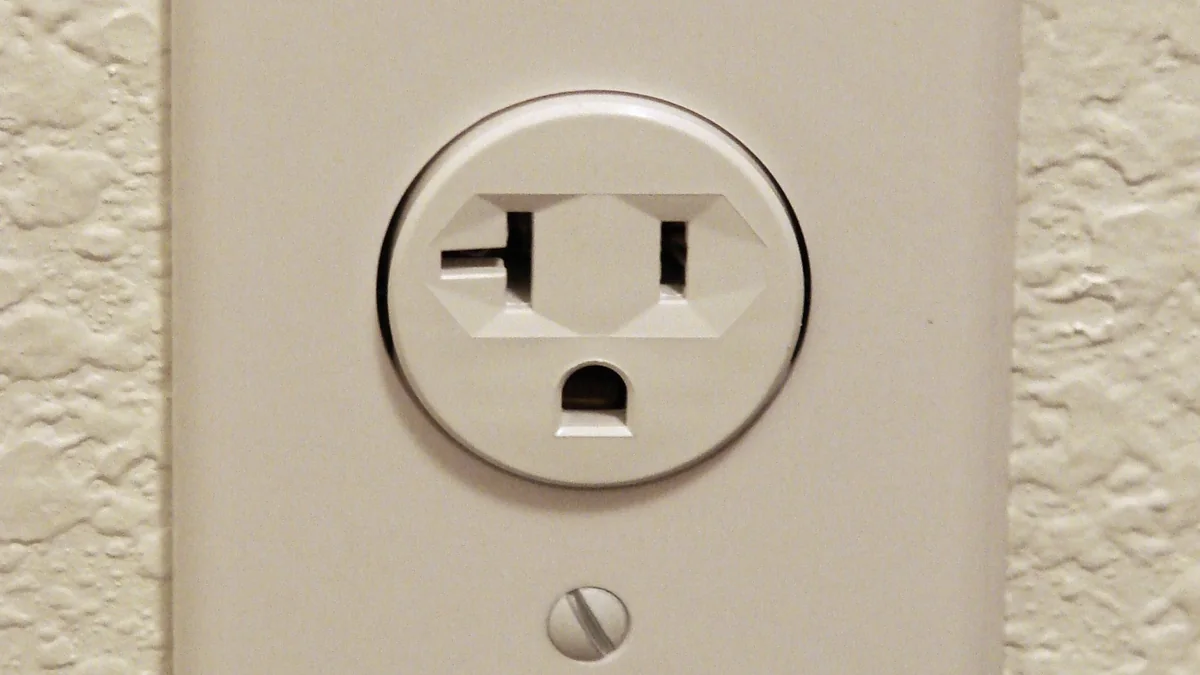
Featured image: a North American wall outlet, photo by David R. Tribble, CC BY-SA 3.0, via Wikimedia Commons.