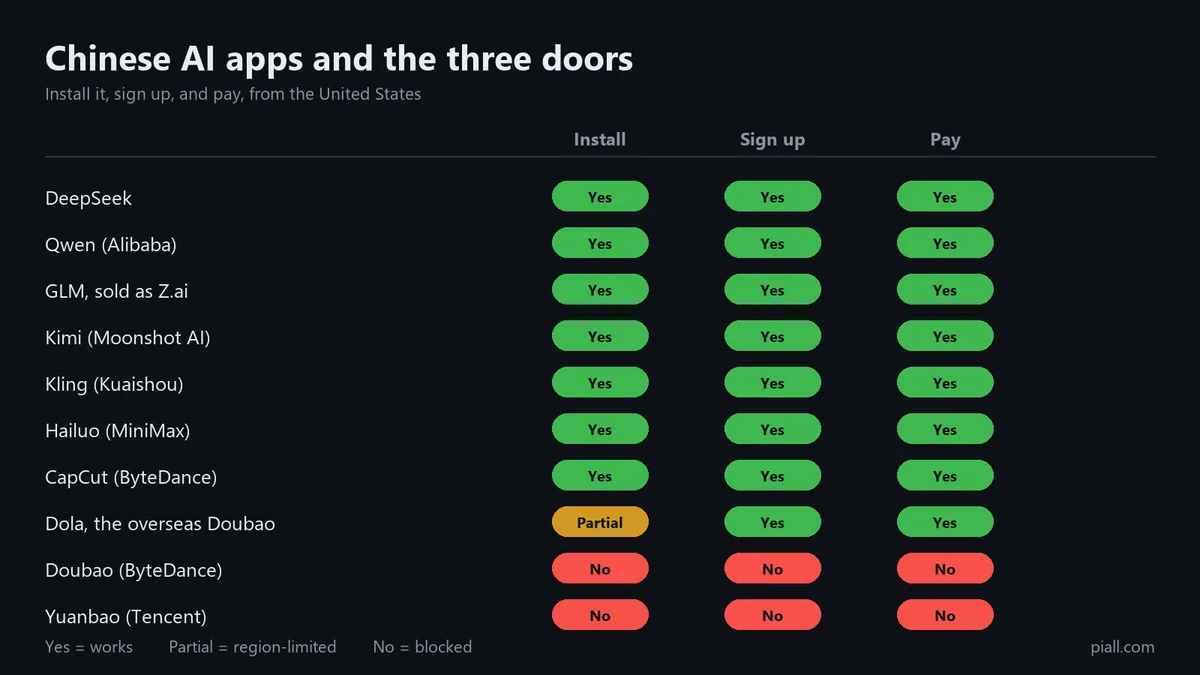
Chinese AI apps post user numbers that would embarrass most Silicon Valley launches. Whether you can use one from the United States is a separate question, and it breaks into three parts.
Door one is the download. Door two is the account. Door three is the money. An app can clear one and fail the next, and the failure usually lands halfway through a sign-up, after you have already decided you want the thing.
Last updated: September 27, 2026. The tables below are the reference. Everything after them explains why the account door is the hard one, and how to check your own case in about five minutes.
Showing 10 of 10 apps.
Doors at a glance
Ten familiar Chinese AI products, checked against the three doors from a US connection. A door that opens with no workaround is marked Yes.
| App (maker) | Install from a US store | Sign up without a +86 number | Pay with a US card | Verdict |
|---|---|---|---|---|
| DeepSeek (DeepSeek) | Yes | Yes | Yes | Works |
| Qwen (Alibaba) | Yes | Yes | Yes | Works |
| GLM, sold as Z.ai (Zhipu AI) | Yes | Yes | Yes | Works |
| Kimi (Moonshot AI) | Yes | Yes | Yes | Works, with a caveat |
| Kling (Kuaishou) | Yes | Yes | Yes | Works |
| Hailuo (MiniMax) | Yes | Yes | Yes | Works |
| CapCut (ByteDance) | Yes | Yes | Yes | Works, with a caveat |
| Dola, the overseas Doubao (ByteDance) | Region-limited | Yes | Free | Not from the US |
| Doubao (ByteDance) | No | No | No | Mainland China only |
| Yuanbao (Tencent) | No | No | No | Mainland China only |
Three of the ten clear the download and then stall at the account. That door decides almost everything, so it is worth understanding before the rest of the table makes sense.
What each one is for
| App | Category | Best for | Free tier |
|---|---|---|---|
| DeepSeek | Chat, reasoning, code | Everyday chat and hard reasoning | Free web chat; free API trial |
| Qwen | Chat, multimodal | A second opinion; images and documents | Free web chat |
| GLM, sold as Z.ai | Coding, agents | Coding agents and long automated tasks | Free chat tier; free API models |
| Kimi | Long documents | Very long PDFs, contracts and codebases | Free tier with monthly limits |
| Kling | Video | Text-to-video and image-to-video | Daily credits, watermarked |
| Hailuo | Video | Character motion and physics | Small trial credits |
| CapCut | Video editing | Editing, captions and templates for short-form | Free, with a reduced feature set |
Why the account door is the hard one
A mainland Chinese phone number is not a formality. Chinese consumer apps are built on real-name registration, and the mobile number is the anchor that holds the whole thing together. A number you cannot keep alive means an account you cannot verify, and an unverified account is no account at all.
That same check is also why these apps have a spam problem the West mostly avoided. Tying every account to a real number raises the cost of a fake one through the roof. The bill for that comes due at the border. The same wall that stops a bot farm also stops a reader in Ohio with nothing but curiosity.
Two of the largest assistants sit behind that wall. Doubao, ByteDance’s consumer assistant, is built for the mainland market and asks for a +86 number at sign-up. Tencent’s Yuanbao ties its account to WeChat or QQ, which is the same wall wearing a different coat. Neither is available in overseas app stores.
ByteDance does run an overseas version of Doubao, now called Dola and previously Cici. It is a separate product for a separate set of markets, and those markets do not include the United States. Its own listings tell US users the service is unavailable in their region. Treat it as a different app that happens to share a model, not as a route around the wall.
I went through the same three doors for the wider family in the earlier piece on which Chinese AI apps actually work in the US, and the shape of the answer has not changed since.
The side door: the web, and the weights
Nearly every company here ships a web version of its chat. A web page does not care which app store your account can see, so the store door is real but rarely the last one. Before you write an app off, open its site in a browser and see who answers.
Open weights are the stronger exit. DeepSeek, Qwen and GLM all publish model weights you can download and run on hardware you control. Qwen’s smaller models run on a decent laptop. The largest ones want real GPUs and real money. Either way, a model running on your own machine cannot be region-locked later, and nobody else holds the account.
One exception is worth flagging, because it catches people out. MiniMax released its H3 video model with open weights whose licence excludes the United States, the EU, the UK and South Korea outright. The hosted Hailuo product still works from the US. Self-hosting the same model does not, and the licence covers the output as well as the weights. Read the terms before you download, not after.
Where people get stuck
Four walls come up again and again.
- The number. A +86 requirement ends the conversation for most people. There is no clean workaround that does not borrow someone else’s identity, which is a worse problem than the one you started with.
- The card. Several paid tiers expect Alipay or WeChat Pay. The apps that clear the money door are the ones that added card billing in dollars, and they are not the majority.
- The region block. Some services refuse US traffic outright. Doubao’s overseas app is the clearest example. The listing can exist while the service refuses to answer.
- The store region. An app that will not download usually means your store account points at the wrong country, not that the app is banned. Check the account region before you blame the app.
A slower risk sits underneath all of it. Chat history on a hosted Chinese service lives on servers under laws you probably have not read, and the terms rarely promise much either way. For a quick question that costs nothing. For anything sensitive, the open-weight route starts to look less like a hobby and more like the only clean option.
How to check your own case in five minutes
- Pick the door that matters. If you only want to chat, start with the web version and skip the store question entirely.
- Open the site, not the listing. If a sign-up form asks for a phone number, look for an email or Google option before you give up on it.
- Read the payment page before you fall for the product. A free tier that ends at a wall you cannot pay through is a two-week trial with extra steps.
- If the free tier is enough, stop there. None of the seven that clear all three doors require payment to try.
- If your data matters, check for open weights first. A download you can hold is worth more than a plan you can cancel.
Two of these repay your time more than the rest. If you only ever use one Chinese model, DeepSeek is the one to start with, mostly because the free tier is generous and every door is already open. If you want the shape of the field before you commit, the roundup of the apps behind the numbers is the place to look.
How this table was built
Every row was checked against the product’s own site or the company’s own documentation, then against store listings where the store was the question. Prices, tiers and regional rules move, which is why the page carries a date and why the date matters. Nothing here is pooled from affiliate roundups. The whole point is that you can re-check a row yourself in a couple of minutes, and the answer should be the same.
The wider point is simple. Availability is not a benchmark. The best model in a chart is useless if you cannot open an account, and the most popular app in China can be the least reachable one here. Check the doors in order, and let the model you can actually reach win by default.
Suggested citation: PiAll, “Chinese AI Apps in the US: Which Ones You Can Actually Use”, https://piall.com/chinese-ai-apps-in-the-us
More on Chinese AI apps in the US
These pieces dig deeper into specific apps and the pricing reality behind them:
- Which Chinese AI Apps Actually Work in the US?
- The Chinese AI Apps You’ve Never Heard of Are Already Huge
- DeepSeek vs GPT-6 Pricing: 60x Cheaper, and Now It Talks
Broader context: if your question is about bringing a Chinese phone or device into the US in the first place, start with our carrier bands and imported-phone guide.