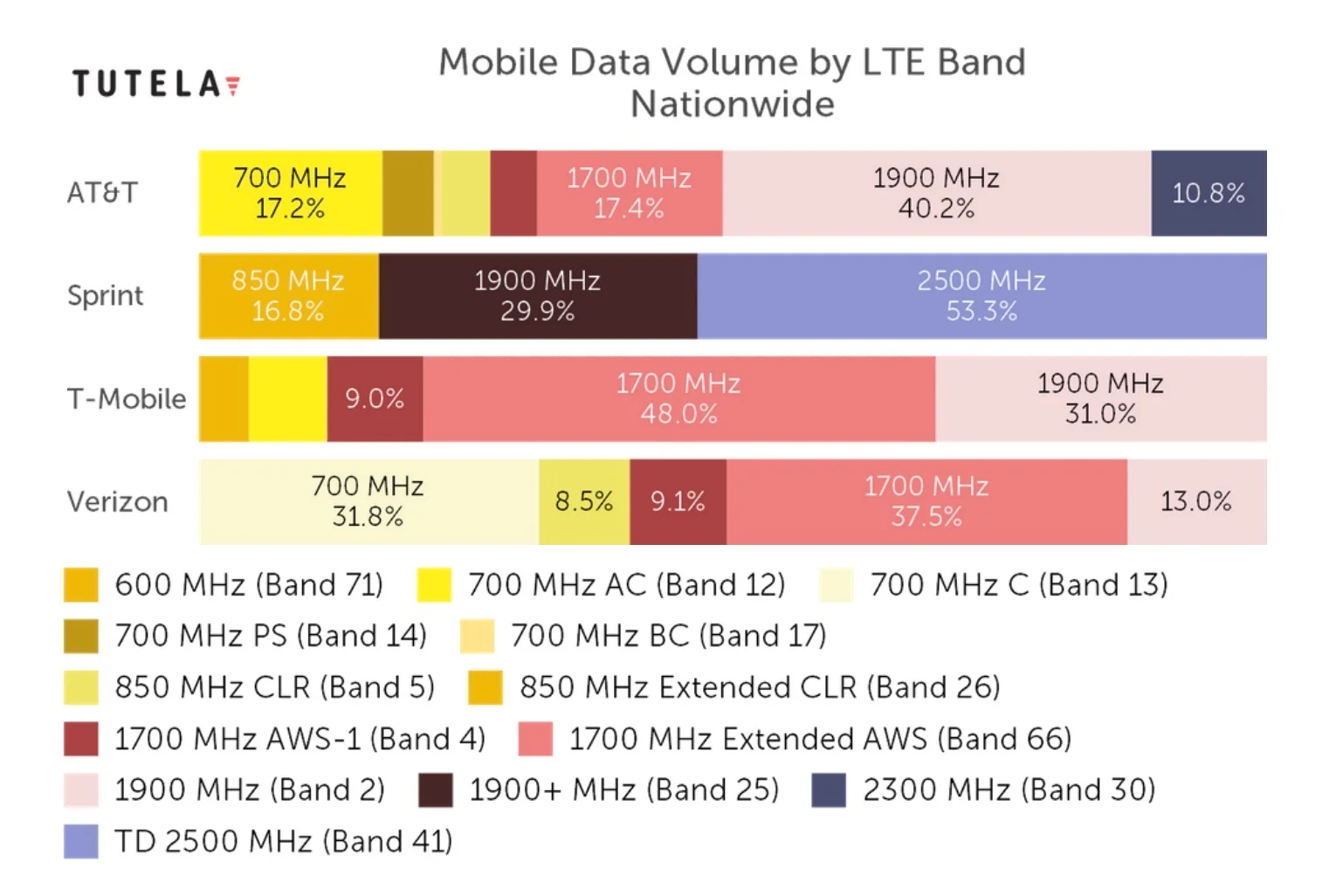
Every phone spec sheet ends with a long line of band numbers that almost nobody reads. If you are importing a phone, that line is the only part that decides whether it works where you live. The rest is noise.
Bands are the specific radio frequencies a carrier transmits on, and the US carrier bands are not the ones a phone built for China or Europe is tuned to. A phone that lacks the main ones drops to slow data in the city and loses signal outside it. The hardware is fine. The radio simply cannot hear the tower.
Last updated: September 19, 2026. The tables below are the reference. What comes after them is how to check your own phone in about five minutes.
The bands each US carrier runs
Every US carrier mixes low-band for coverage with mid-band for speed. Low-band travels far and pushes through walls. Mid-band is several times faster and reaches a few miles at best. A phone that feels normal needs both.
| Carrier | 4G LTE bands | 5G bands | The ones that matter |
|---|---|---|---|
| T-Mobile | 2, 4, 5, 12, 66, 71 | n2, n25, n41, n66, n71, n260, n261 | n71 for reach, n41 for speed |
| AT&T | 2, 4, 5, 12, 17, 30, 66 | n2, n5, n30, n66, n77, n260 | 12 and 17 for reach, n77 for mid-band |
| Verizon | 2, 4, 5, 13, 48, 66 | n2, n5, n66, n77, n260, n261 | 13 for reach, n77 for mid-band |
AT&T and Verizon put their mid-band 5G on n77. That is the C-band slice that took years and a fight with the airlines to switch on. T-Mobile uses n41 instead, the same band China Mobile runs in every Chinese city, and that coincidence matters more than any other line on this page.
What a phone sold in China is built for
A phone made for the Chinese market is tuned to Chinese networks, and those networks are close to the mirror image of the American ones in almost every respect. China leans on mid-band and TDD frequencies. The US leans on low-band FDD.
| Chinese network | 4G LTE bands | 5G bands |
|---|---|---|
| China Mobile | 3, 8, 34, 39, 40, 41 | n28, n41, n79 |
| China Unicom | 1, 3, 8, 40 | n1, n78 |
| China Telecom | 1, 3, 5, 40 | n1, n78 |
Now go looking for the American bands in that table. Band 12 is not there, and neither is band 17. Band 13 and band 71 are missing too. And n77 is absent as well, though n78 sits close enough in frequency that the pair get mixed up constantly.
None of that is a mistake or a cost-cutting trick. Every band costs money in hardware and certification testing. A phone that will never be sold in Ohio has no reason to carry the frequencies Ohio runs on.
mmWave follows the same logic. China has not deployed n260 or n261 in any real volume, so Chinese phones rarely include them. That is the least painful gap of the lot. mmWave covers a few city blocks, and most people never notice it is absent.
Where imports break, and why it is always the same way
| Band | Who runs it | What you lose without it |
|---|---|---|
| 12 and 17 (700 MHz) | AT&T, T-Mobile | Indoor signal and rural coverage collapse |
| 13 (700 MHz) | Verizon | Verizon coverage turns patchy, even in cities |
| 71 and n71 (600 MHz) | T-Mobile | No Extended Range 5G, weak signal away from town |
| n77 (3.7 GHz) | AT&T, Verizon | 5G appears on screen but stays on the slow layer |
| n260 and n261 (mmWave) | Verizon, AT&T | No gigabit bursts downtown or in stadiums |
| n41 (2.5 GHz) | T-Mobile | Nothing, if the phone came from China |
Read the middle column of that table from top to bottom. The pattern is plain. Almost every band a Chinese phone lacks is a low band. Low bands are the ones that carry a signal through concrete and across open country.
One more layer sits underneath all of this. A phone can list every right band and still underperform. Carriers lean on band combinations, which means holding two or three frequencies at the same time, and those combinations are certified model by model rather than band by band. A phone with n71 on paper can still miss the exact pair its tower is using.
So the failure is not random and it is not gradual. A Chinese phone in the US tends to work well downtown and on main roads. Then it stops in a basement. Then it stops in a parking garage. Then it stops on a highway between two towns.
That is a description of a low-band problem. Low band is exactly what the phone was never built to hear.
There is a second trap, and it has nothing to do with China. Two phones with the same name can carry different radios. A Galaxy S25+ sold in Europe lists n77 and n78, which looks like full US support. It still leaves out n71 and every mmWave band. The version sold in the US adds n71, n260, and n261, along with LTE band 71.
Apple does the same thing on purpose. mmWave 5G has been exclusive to US iPhone models for years. An iPhone bought in London carries no n260 or n261 hardware at all, no matter which carrier you put it on.
So the model number matters more than the model name. This is the most common way people buy the wrong phone.
If you remember one sentence from this page, make it this one. The further you are from a city center, the more the missing bands cost you.
Which carrier to pick
T-Mobile is the safe first choice for an imported phone, and n41 is the reason. That band is both T-Mobile’s main 5G capacity layer and China Mobile’s main band. A phone bought in China usually already carries the radio for it.
n71 is still missing, and that costs rural reach. But the fast lane works.
AT&T is the hardest of the three. It keeps an approved-device list for voice. If your exact model variant is not on that list, calls fail even when data connects cleanly.
Verizon sits in the middle. It checks the IMEI at activation and lets most current phones through. Older and unusual models get refused at the counter.
An MVNO riding on T-Mobile’s network is the cheapest way to test. Buy one month. Carry the phone for a week to the places you actually go, because a speed test inside a store proves nothing about the basement where you park.
The blocker that is not a band: voice
US carriers shut down 3G. Every call now travels over the LTE network as data. That is VoLTE, and it needs more than a compatible radio. The carrier has to have certified your specific model for voice on its own network.
This produces the strangest failure of the whole exercise. The phone shows full bars. Apps load quickly, and then every call fails or drops to an error. Data works. Voice does not.
I went through the approval problem properly in the checklist on Chinese phones in the US, including what to ask a carrier representative and why the answer depends on the exact model number. If voice is the only thing broken on your phone, that is the page to read next.
Check your own phone in five minutes
- Find the exact model number, not the marketing name. It is under Settings, then About phone. Two phones sold under one name often carry different radios.
- Look up the NR and LTE band list for that exact number. GSMArena and the manufacturer’s own spec sheet are the sources that hold up.
- Match the list against the essentials. For T-Mobile that means n71 and n41. For AT&T and Verizon it means n77.
- Run the carrier’s own checker with the IMEI. All three publish one, and it answers the voice question that a band list cannot.
- If the phone is a China-only model and you mostly stay in cities, expect it to work. If you drive long distances or live outside a metro area, expect gaps and plan around them.
One more thing to check before you buy, because it ruins more first evenings than bands do. Voltage and plugs are a separate problem, and I covered what actually works in the piece on Chinese chargers and appliances. Bands get all the attention. The plug is the thing that leaves you with a dead phone at midnight.
Bands are boring, and they decide everything. The good part is that the answer takes five minutes. And it is the same answer every time. A phone built for China is built for China.
Suggested citation: PiAll, “US Carrier Bands: What an Imported Phone Actually Needs”, https://piall.com/us-carrier-bands-imported-phones
Which Chinese phone should you actually buy in the US?
The band table above tells you whether a phone will work here. The next question is which one to buy — and that’s where availability and warranty matter more than raw specs.
| Brand | Official in the US? | How you actually get it | Bottom line |
|---|---|---|---|
| Xiaomi / Redmi / POCO | No | Import (AliExpress, Amazon third-party, eBay) | Great specs, zero US warranty |
| OnePlus | Yes | OnePlus.com, Amazon, some carriers | The safe Chinese pick |
| Nothing / CMF | Yes | Nothing.tech, Amazon, carriers | Stylish and properly supported |
| Honor | Limited | Import only | Unclear US future |
| Realme | No | Import only | Niche, unsupported here |
Why most aren’t sold here officially
It’s rarely about quality. “Sold in the US” means clearing hurdles most brands skip:
- Carrier certification — Verizon, AT&T, and T-Mobile each require lengthy, paid certification on their bands.
- Band mismatch — China and US use different LTE/5G bands; a model tuned for Asia may miss key US ones.
- Google services & updates — buyers expect the Play Store and timely patches out of the box.
- Support logistics — a US warranty program and support line are real ongoing costs.
OnePlus and Nothing decided the US was worth it. Xiaomi, Redmi, POCO, Realme, and Honor mostly didn’t — so for those you’re in gray-market territory.
Official channels (OnePlus, Nothing): the low-drama path
Buy here and returns, warranty, and updates behave like any local phone. OnePlus sells directly, via Amazon, and sometimes carriers, with North-America-tuned bands and a US warranty. Nothing / CMF sells via its own store and Amazon with US bands and Google services preinstalled.
Gray market / importing (Xiaomi, Redmi, POCO, Realme, Honor)
This is where the tempting specs live — and where the fine print bites. “Global version” usually means broader bands and Google services versus the China ROM, but it may still miss a couple of US bands (notably n71 on T-Mobile and some Verizon LTE). People buy from AliExpress, Amazon third-party sellers, and eBay.
Importing — the good
- Specs-per-dollar US-flagged phones can’t match
- Access to models never sold here (flagship Xiaomi, POCO gaming phones)
- Often unlocked, no carrier bloat
Importing — the catch
- No US warranty — if it dies, you eat the cost
- Returns mean shipping back to an overseas seller
- Longer waits and possible customs hiccups
- Regional firmware and slower security updates
Warranty & returns reality
The biggest gap between “official” and “import” isn’t price — it’s what happens when something breaks. An officially sold OnePlus or Nothing is treated like any local phone. An imported Xiaomi is, practically, your problem: the global warranty rarely covers US buyers, and a “return” is a transcontinental shipping exercise. Go in informed and importing is fine; go in expecting local-style support and you’ll be frustrated.
We’re publishing brand-by-brand guides — Xiaomi/Redmi/POCO in the US, OnePlus vs Xiaomi head-to-head, and how to import safely — and will link each one here as it goes live.
More China-in-the-US guides
If you are bringing a phone from China, buying one there, or just trying to make it work on US networks, these guides cover the gaps the carrier band table above does not:
- Chinese Phones in the US: Bands, IMEI, and VoLTE Checklist
- Chinese Chargers and Appliances in the US: What Works
- Does Your Chinese Phone Support eSIM? A 10-Second Check
- Why Google Wallet Stops Working on Chinese Phones
- Wi-Fi 7 Without 6GHz: What Chinese Phones Leave Out
- Can You Import a Chinese Car or E-Bike Into the US?
- What You Can’t Ship From China to the US
- Why Xiaomi Still Doesn’t Sell Phones in the US
- Shipping From China to the US: What It Costs Now
Most of these are evergreen checklists — bookmark the ones for your device before you travel or import.