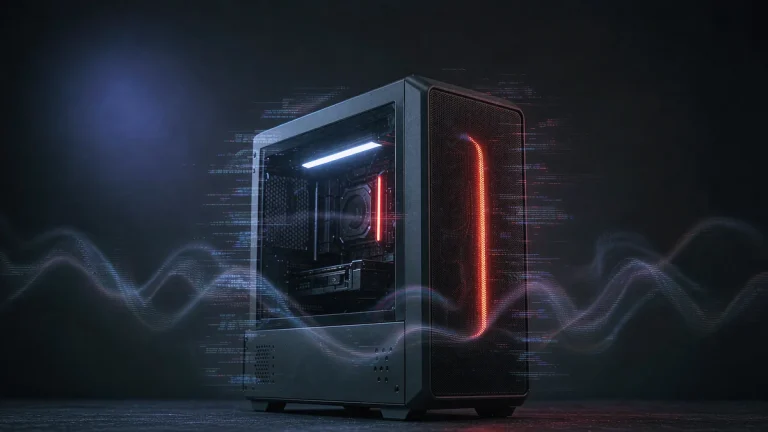
“100% domestic” is a supply-chain claim before it is a product claim. Huawei used it this week for a desktop machine built without Intel or Qualcomm parts, and the phrase travelled much further than the specification sheet did. What it describes is real. What it does not describe is larger, and considerably more useful to understand.
A finished computer is the last step of a very long ladder.
Six different things can be called domestic
Consumer coverage tends to treat “domestic” as a single property, as though a machine either is or is not. In practice the word applies independently at each rung of the stack, and a machine can be domestic at one rung and entirely dependent on imports at the next.
- Architecture and chip design — who owns the instruction set and the blueprints.
- Fabrication — which foundry actually etched the silicon, and on what equipment.
- Packaging and test — where the die becomes a usable chip.
- Memory, storage and display panels — commodity parts with their own supply chains.
- Operating system and drivers — the software layer that makes the hardware usable.
- Final assembly — the box, the board, and the screw that holds it together.
The final rung is the easiest one to reach and the one a marketing phrase most often refers to. The first three are where a decade of industrial policy lives. Conflating them is how a genuine engineering milestone gets reported as something it never claimed to be.
Why desktops are the sensible place to start
A desk-bound machine is a forgiving target. It has a large power budget, generous thermal headroom, no battery, and no radio certification across dozens of bands. A part that would be disqualified from a thin laptop by heat or standby draw can work perfectly well in a tower with a fan the size of a hand.
That matters more than it sounds. The hardest constraints on a fully local bill of materials are not raw compute, but the components that have to be small, cool, and frugal at the same time. A desktop lets a supplier prove the stack works before attempting the version that has to fit in a lap.
Being first in a tower is not a compromise. It is the order in which the problems become solvable.
There is also a procurement dimension. Institutional buyers often have requirements written in terms of origin, auditability, and long-term parts availability rather than benchmark scores. For that audience, a labelled machine with a documented supply chain answers a question that a faster machine with an opaque one does not.
What the phrase usually leaves out
Three things, consistently. The first is the equipment used to make the components. A chip designed and fabricated in one country can still depend on lithography tools, design software, or substrate materials sourced elsewhere; origin labels track the part, not the factory’s toolchain.
The second is the peripheral ecosystem. Printers, docking stations, specialised cards, and the drivers for them do not become domestic because the tower is. Compatibility is where a spec sheet turns into a support ticket, and it is the part of a migration that institutional buyers budget for and press coverage skips.
The third is software availability. An operating system can be local while the applications a workplace actually runs are not. Migration is measured in the number of workflows that keep working on day one, not in the origin of the kernel.
How to read the next announcement
Watch for specificity. A claim that names the processor, the memory vendor, and the operating system is making a verifiable statement. A claim that only names the finished product is making a branding statement. Both can be true at once, but only one of them tells you what changed.
Watch for volume as well. Announcing a machine and shipping it in quantity are different milestones, and the gap between them is where supply constraints show up. A configuration listed for institutional procurement has a different meaning from the same configuration sitting in a retail channel with a return policy.
Finally, watch whether the label survives the next product. A one-off tower proves a bill of materials can be assembled. A second machine, in a different form factor, proves it can be repeated. Repetition is the actual claim, and it is the one no press release can make on launch day.
The part worth keeping
None of this diminishes the engineering. Building a working general-purpose computer without the two companies that defined the category for two decades is a substantial integration job, and the integration is the hard part: firmware, drivers, thermals, and a boot sequence that behaves the same on the thousandth attempt as on the first.
But the honest reading is narrower than the headline. This is a working desktop with a documented local stack, announced into a market where documentation is itself the product. Whether that stack scales into laptops, servers, or consumer retail is a separate question, and the announcement does not answer it.
First-party material is sparse, which is normal for an institutional launch. Huawei’s public reporting covers supply-chain strategy at a level far above any single SKU, while independent teardowns are the only way to verify what is actually on the board. Until one appears, the label is a claim about the assembly, not an inventory.