What “in-house” actually means here
The Huawei Mate 90 series launched in China this September. The line everyone repeats is that it is the most self-contained flagship on the market. That sounds like marketing until you look at what is actually inside.
The processor is Huawei’s own Kirin 9050. The operating system is HarmonyOS 7, built with no Android compatibility layer at all. The camera system is Huawei’s own XMAGE brand. Three of the four things that define a modern phone were designed and built by the same company that puts the sticker on the back.
Most flagships are assemblies. A phone sold in the US might carry a Qualcomm or MediaTek chip and run Google’s Android, licensing its camera pipeline from somewhere else. None of that is wrong. It is just a different strategy.
Huawei’s plan, after years of being cut off from those supply lines, became to own the stack. The Mate 90 is where that bet shows up most completely, and it now touches every part of the phone.
The chip is the part worth understanding. The Kirin 9050 uses what Huawei calls LogicFolding, a method of stacking logic circuits vertically instead of only shrinking them. The claimed transistor density lands near 238 million per square millimeter, which the company says puts it close to an early 3-nanometer process.
I am not going to pretend those numbers mean much to a normal buyer. But the method behind it is the news. What they mean is that Huawei found a path to a competitive chip without the most advanced manufacturing equipment. That is the real story of this phone.
And it has an obvious second act. If stacking works, the race stops being only about who owns the newest lithography machine. It becomes a race about packaging, design, and power instead. More companies can enter that one.
None of that makes the Mate 90 faster than an iPhone in your hand. That is not the claim, and Huawei is not making it. The claim is narrower and more durable. A company that designs its own silicon, its own system and its own camera stack has options that a company assembling parts simply does not, and options outlast any single benchmark score.
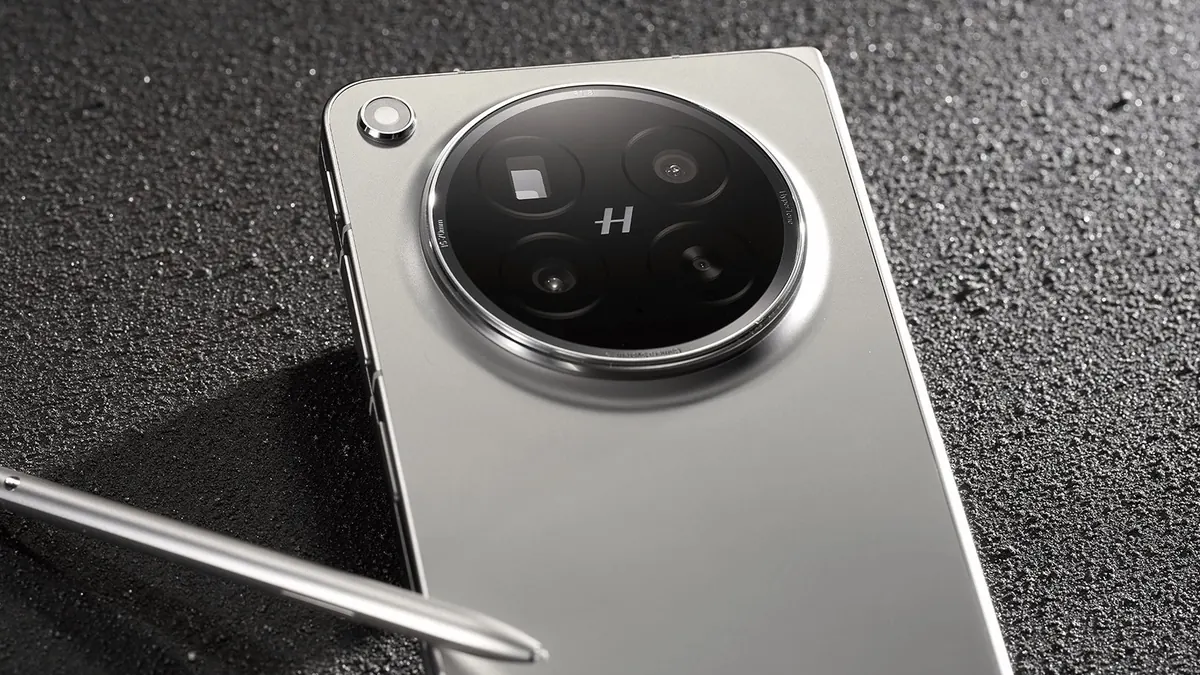
The camera is the third pillar, and it is the easiest one to overlook. Huawei’s XMAGE brand covers the sensors and the processing, and it also shapes the look of every photo the phone takes. Again, this is Huawei’s own work, not a licensed pipeline from a Western supplier.
The point is not that Huawei’s choices are better. Only that they are its own. And that independence is the one feature no other major flagship can honestly claim this year.
There is a cost to that independence, and it does not show up on a spec sheet. Build your own operating system and you also have to build your own app catalogue. A catalogue is measured in years, not in transistor counts. Huawei has had years. It has not had as many as Google.
Two things are easy to mix up here. Capability and access are not the same thing. Huawei solved the first and left the second alone. That is worth keeping straight.
The part that matters for you
Here is the angle that actually matters if you are reading this from outside China. First, you cannot buy a Mate 90 through normal US channels, because the same wall that keeps Xiaomi and most other Chinese phones out of US carrier stores applies here too. I broke down why that wall exists in my Xiaomi piece, and the reasons are nearly identical.
If you really wanted one, you would import it. Then you would hit the second problem. HarmonyOS 7 has no Android layer, which means no Google Play, no sideloaded apps, and no Gmail or Maps unless there is a web version you are happy with. So the software is the wall.
The phone runs native HarmonyOS apps, and the native store is, predictably, China-centered. For a buyer in the US or Europe, that is the single biggest tradeoff, and it is not a small one. A beautiful, fast, well-built phone is still a phone you cannot use the way you expect.
Put a number on that tradeoff and it stops being abstract. Every app you open without thinking becomes a question mark. Your bank, your airline, the parking app in your city. Most of them have no HarmonyOS build, and none of them will make one for a phone that never went on sale where you live.
One more practical note. If you did import one, you would be on your own for service. No local warranty, no walk-in repair, and a resale market that starts near zero. That is a real cost, and it never shows up in a spec comparison.
So my honest read is this. The Mate 90 is a genuine engineering achievement and a clear signal of where Huawei thinks the industry is going, but it is also not a phone I would tell a Western buyer to chase. The hardware is real. The world it was built for is the catch.
The rest of the spec sheet is what you would expect from a 2026 flagship. Batteries run from 6,500 to 7,500 milliamp hours depending on the model, with wired charging up to 120 watts and wireless at 80. The top screen peaks near 8,000 nits.
The camera system scales up to a 200 megapixel main sensor with ten times optical zoom on the most expensive variant. That is the kind of hardware that used to require a dedicated camera. None of those numbers change the core point, but a phone is more than its parts list.
Huawei proved it could build the parts. Whether that adds up to a phone you would want depends entirely on whether you live inside the system it was built for. And almost nobody reading this in English does.
So who is this phone for? Mostly people who already live in Huawei’s world. The hardware deserves an audience it cannot reach. That gap is not a flaw in the phone. It is a flaw in the map.
There is a practical angle for American readers too. This phone is a preview of what Huawei would sell you if it ever returned to Western retail. The answer to “why can’t I buy this” will not change just because the hardware got good.
There is a quieter point underneath all of this. For years the assumption was that a Chinese flagship could only compete on price or on specs borrowed from Western suppliers. The Mate 90 argues the opposite. When the chip, the system and the camera are all yours, you are not racing the same race. And that is the real shift.
I would push back on one framing, though. Treating this as a purely technical story misses the commercial half. A phone like this is a signal to every other manufacturer that the hardest parts are no longer a closed club.
There is one more habit worth dropping. Reading every Chinese flagship as a copy of something else. The Mate 90 is not catching up to anyone. It is running a different playbook, and the playbook is the story.
Watch what happens to that strategy next. If LogicFolding scales, the interesting question stops being whether Huawei can match a 3-nanometer part. It becomes whether anyone still needs to.
Whether that separate race produces something a global buyer wants is still an open question, and Huawei knows it. That is the judgment I would leave you with. Watch this phone as a sign of where manufacturing is heading, but do not mistake it for something you can or should buy this year.
The same pattern shows up in China’s AI too, but the consumer product gap is a different conversation.