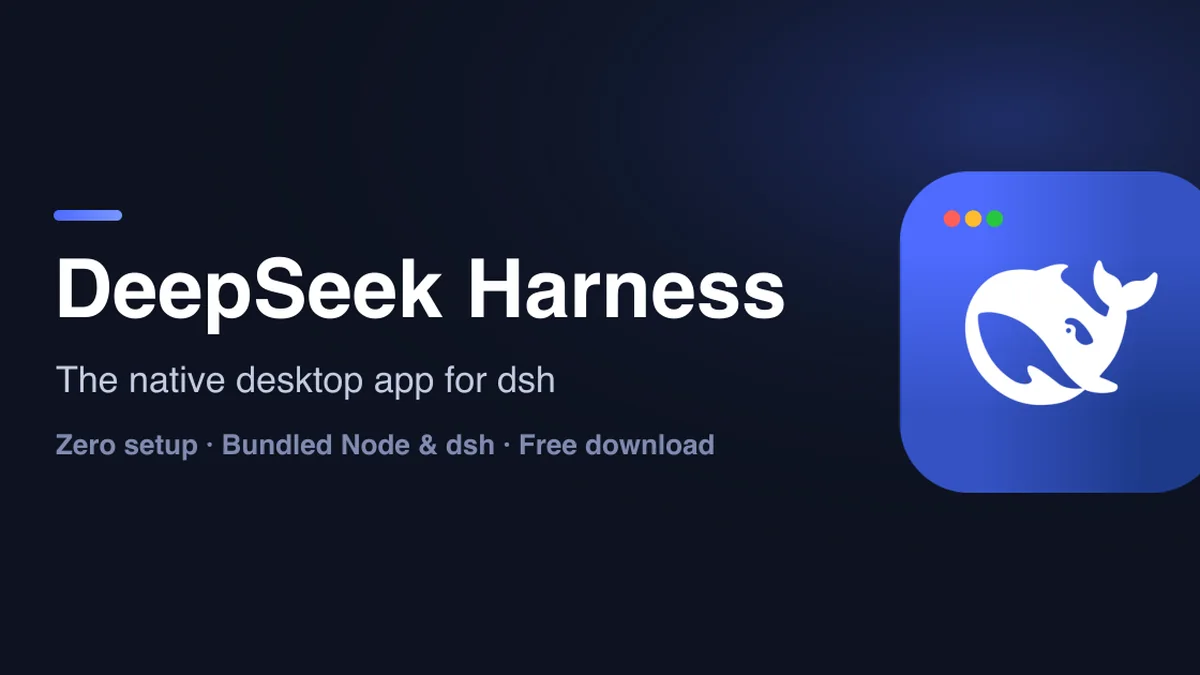
DeepSeek’s official Harness desktop app is nearly ready. Run V4.1 Flash daily? Then this is the client worth waiting for.
Here is the state of it. A few days ago people noticed a desktop client branch inside the DeepSeek Harness repository. Compiling it yourself was the only way to run it. Now the main branch carries a complete apps/desktop directory, with builds for macOS on Apple Silicon, macOS on Intel, and Windows x64.
No Linux build, though.
When it ships, expect it on download.deepseek.com. Nothing is posted there yet. But code landing in main usually means the finish line is close. DeepSeek has every reason to move fast while the hype is still hot. The web client is not going anywhere either, and it will stay the fastest way to poke at a new release.
Some background for anyone who came in late. DeepSeek launched Harness in mid-August, next to the V4 Pro release. The client was web-only back then. The repo blew past 100,000 GitHub stars within days, and third-party developers rushed to fill the desktop hole with their own wrappers. I dug into what that star record actually meant in a separate post, and the short version is that the number is real but the story behind it is more interesting.
Why does a desktop app matter when the web version already works? File access. An agent that only sees what you paste into a browser tab is a demo. An agent with a real path into your project directory is a tool. That is the difference.
Why the official build is different
Both kinds of app wrap the same web interface in Electron. The interesting part sits underneath. Community builds pass data over a local port on your machine. The official app skips the port entirely and uses its own dsh-app:// protocol.
That sounds like trivia. It is not. A local port is a door that any process on your computer can knock on. A custom protocol closes that door. For a tool that runs shell commands and reads your project files, that difference is worth caring about.
Think about what the client actually gets access to. Your source tree, your environment variables, your keys if they sit in the open. A wrapper listening on localhost is one bad firewall rule away from being reachable. The official build removes the listener.
Packaging is the other upgrade. The official build bundles everything. Shell, runtime, backend, one version number. Third-party setups keep the pieces apart. Version mismatches are where the bugs breed, and nobody enjoys debugging a wrapper that broke because one dependency moved.
There is a pattern here I find mildly funny. Every popular dev tool gets a desktop wrapper within a week now. Every wrapper gets praised as the real experience, right up until the official one shows up. Then everybody quietly migrates, and the wrappers drift into maintenance mode. The DSH wrappers are next in line.
The V4.1 Flash angle
DeepSeek said it from day one. V4.1 Flash is jointly optimized with its own client. Their published tests show the best performance in minimal mode on DSH itself. You can run the model anywhere, and plenty of third-party clients will happily load it. You just leave some of its speed on the table when you do.
Joint optimization is one of those phrases that sounds like marketing. But here the seam is visible. The same company ships the model and the client, so it can tune token handling, context trimming, and cache keys on both ends at once. Third parties can only guess.
Minimal mode strips the client back to the basics. That is where the joint work shows up. The fancier the interface layer gets, the more it stands between you and the model. This is one of the few cases where the plainest settings also win on raw speed.
Caching is the part you actually feel. People who run DSH daily report cache hit rates above 95 percent, though no formal benchmark backs that up. And it makes sense. A coding agent resends enormous amounts of unchanged context on every single turn. A high hit rate turns those resends into nearly free tokens.
That is the difference between a cheap session and an expensive one. It is also the kind of thing you cannot fix from a third-party client, because the caching behavior lives in the pairing between the model and the client.
The past few days added a side argument about thinking modes. Max reasoning is the strongest and most expensive setting. It is built for long, brutal tasks. High already matches or beats it on ordinary work. Low, or even off, is plenty for simple questions and quick edits.
So my rule is simple. High for real work. Low or off for quick stuff. Max only when a task has earned it.
Most people will never need Max. And the people who do already know who they are. Even the heavy users in this week’s threads said the same thing, which usually means the default is set too high.
There is a fair worry on the other side of all this. An official client is a tighter leash. It knows what you run, and it updates on its own schedule. If you care about pinning a tool to a version you have tested, a community wrapper is still the more controllable option.
Should you compile the desktop branch today? Only if you enjoy fixing build errors at midnight. Everyone else should wait for the installer. By every sign it is days away, not months.
Is the wait worth it? For most people, probably not yet. The gap between the web client and the official desktop build is real but narrow. If you live in a browser all day, you will barely notice the difference.
The practical takeaway is timing. Keep using whatever you use this week. When the installer lands, switching takes minutes, and your API key moves with you. There is no reason to rush, and no reason to switch twice.
There is a bigger question sitting under the release. Who owns the last mile between you and the model? Right now, for most people, the answer is a browser they did not choose and cannot audit. An official client does not answer that. It just makes the middle layer someone you can name.
Getting started costs almost nothing on the web client today, and I went through the whole thing step by step in a ten-minute walkthrough earlier this month. None of that should change. Your keys and settings carry over.
So what would actually make me switch? Not the protocol, and not the packaging. It would be the first time a long refactor finishes without me watching the token counter.
One gap worth watching. Linux is left out entirely, and DeepSeek has not said whether that changes. For a project that leans this hard on its community, skipping the platform much of that community runs on is a strange call. And if Linux never arrives, the third-party wrappers suddenly have a real reason to exist.
I could be wrong about the timing, by the way. An Electron app that looks finished in main can sit for weeks while a team argues about code signing and auto-update. A merged directory is not a download link.