In February, Brazil’s telecom regulator authorized a Chinese constellation to sell satellite internet to Brazilians. Up to 324 satellites, licensed through July 2031. It was the first time a Chinese low-orbit system was cleared to operate in Latin America.
The company is SpaceSail, known at home as Qianfan. It had roughly 200 satellites in orbit by the middle of this year, wants 15,000 by 2030, and builds about 500 a year. Its first paying service tracks ships at sea. Its first consumer offering is aimed at Brazil in the fourth quarter.
Now compare the incumbent. Starlink had more than 7,000 working satellites by mid-2026 and around 10 million customers across about 100 countries. In Brazil it holds roughly 78% of satellite connections, with more than a million subscribers.
But the number that explains this story is smaller. Six. SpaceSail told Anatel it will build at least six ground stations in Brazil, including sites in São Paulo and Brasília, plus a network operations center.
The ground. Not the sky.
Coverage is a fact of physics. Service is a fact of law. A satellite passing over your house covers you whether or not anyone ever sold you anything, and that gap explains almost everything about why satellite internet reaches some countries and skips others.
Registration is not permission
Start with the paperwork that isn’t the paperwork. Operators file with the International Telecommunication Union for spectrum and orbital slots. Those filings are real, and they establish priority.
They are also routinely described in press coverage as if they granted market access. They do not. A filing is a place in a queue, and it sells nothing to nobody.
The permission that matters is landing rights. The phrase comes from aviation, where it means a foreign carrier’s right to land in another country. For satellites it means a sovereign state agreeing that a foreign system’s capacity may be used commercially inside its borders.
Two things about landing rights are worth knowing. There is no universal definition. The ITU doesn’t use the term, and neither does the World Trade Organization.
Each country names it differently and sets its own price. Nigeria charges around $20. Kenya charges $12,000 or more.
And the second thing is the one people miss. An ITU registration does not remove the requirement. A network can be filed perfectly and coordinated fully, and still be legally unable to sell one subscription in the country underneath it.
Then comes the corporate part. The rule in Brazil is that landing rights must be held by a locally incorporated entity. Indonesia and Mexico work the same way.
So a foreign operator has to stand up a subsidiary or contract a local partner before it can file at all. That rule is a fossil of the 1980s, when closed-skies policies meant only local systems could serve local customers. Open-skies reform, pushed along by the 1998 WTO telecom agreement, started clearing it away.
Europe cleared most of it. The European Union phased landing rights out under a 2002 directive, which is why Starlink arrived there as a consumer product instead of a negotiation. Much of Africa and the Middle East, and most of the Asia-Pacific, still run the older system.
And landing rights are only one of three doors. A ground station needs its own license, site by site, with antenna coordinates and interference studies attached. Selling service to people needs a telecom service license. The dish in your yard usually needs a type approval of its own. Miss any one of them and the constellation overhead is scenery.
The gatekeepers changed jobs
If this were only about paperwork, the most successful satellite operator in history would have sailed through. Starlink is stuck.
India is the clearest case. In November 2022, the telecom department told Starlink to stop taking pre-orders and refund deposits, because it held no license. A license finally arrived in June 2025.
Regulators then issued licenses and spectrum assignments to Starlink, Jio and OneWeb in February 2026, though the price of that spectrum is still unsettled. By June, reporting said the security clearance had frozen.
Part of that is about control of cross-border traffic, which India treats as a sovereignty question. Part of it is simpler. Reliance Jio has applied for a 1,650-satellite constellation of its own. When a domestic champion is waiting in the same queue, the queue tends to move slowly.
South Africa is stranger still. Starlink cannot apply at all. Licensing rules require 30% ownership by historically disadvantaged groups.
The company has offered a R500 million investment, roughly $27 million, to connect 5,000 rural schools instead, arguing that should count as compliance. Whether you read that as generosity or as negotiating the definition of a rule, the point stands. The argument is not about coverage. It is about who is allowed to own the pipe.
Brazil went the other way. Brazilian regulators did not open the door because they prefer Chinese satellites. They opened it because a single operator holds about 78% of the country’s satellite connections, and a second supplier is the cheapest way to change that number. Same gate. Opposite purpose.
So landing rights have quietly changed jobs. They used to be about interference and national sovereignty. Now they are a lever. Who serves, and who has to wait.
The United States runs the same machinery under different labels. A foreign-licensed system needs market access from the FCC, and large low-orbit constellations post a performance bond of up to $100 million against deployment milestones.
A bill working through the Senate, the Secure Space Act of 2025, would go further. It would bar the FCC from granting licenses or market access to any company on the agency’s Covered List, or an affiliate of one. Huawei and ZTE sit on that list. Control is the test. Location is not.
Read that carefully, because it is the direction of travel. Ownership decides access. Not engineering. Not who built the hardware.
Which brings me back to the six ground stations. Any country that approves a constellation but insists the ground segment be local, staffed with its own engineers, and switchable on official order is telling you what it actually cares about. The sky is shared. The dirt is not.
The rules are still being written, and that is worth watching for its own reason. Delegations revisit the unauthorized-landing question at a World Radiocommunication Conference in 2027, where the argument is how much a regulator can control terminals it never approved. Nobody is debating whether satellites should see borders. They are debating who enforces the ones that exist.
My prediction, and it is falsifiable. Within two years, the fights that get covered will not be about launch cadence or satellite counts. They will be about who owns the ground segment inside each country, and about whether the local-entity rule spreads.
Watch two signals. Whether more countries copy Brazil’s competition logic or South Africa’s ownership test. And whether an ownership clause like the Secure Space Act becomes law somewhere.
If you are an American waiting for a third or fourth satellite option, the thing to watch is not a rocket. It is a docket. Your choices in two years will be decided in a hearing room, by people who never look up.
This is the same pattern that runs through the phone market and through electric cars. Nothing is missing from the product. Permission is missing from the market, and permission is the harder thing to build.
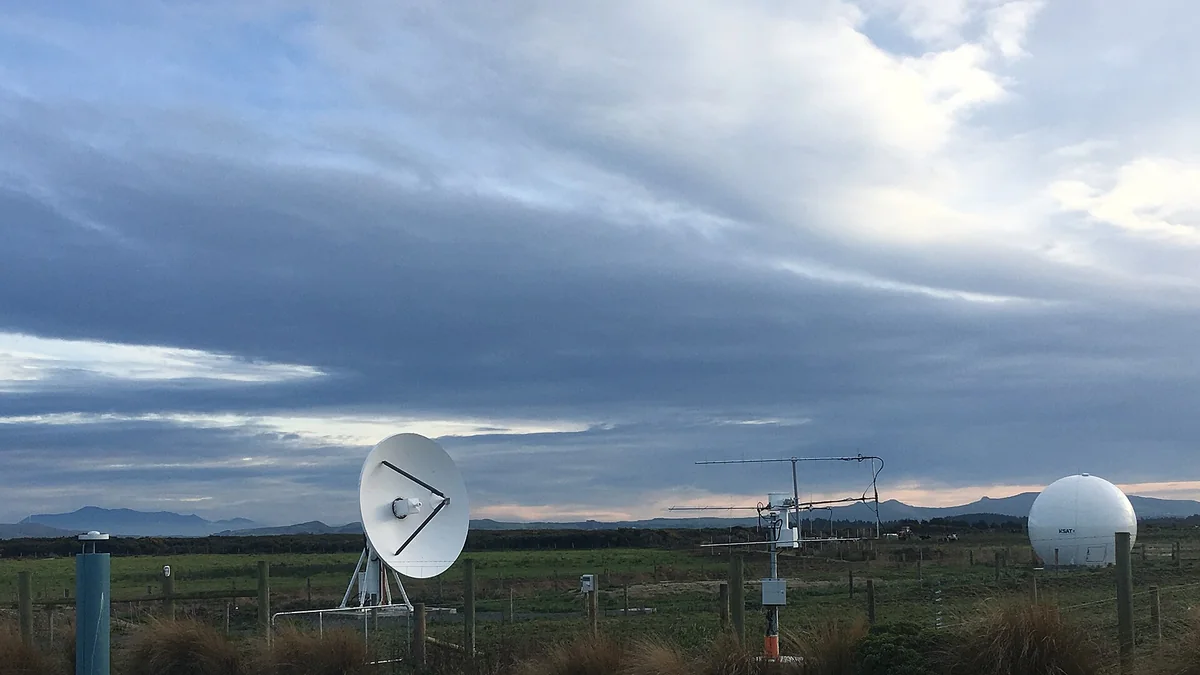
Featured image: antennas at the Awarua Satellite Ground Station in New Zealand, photo by Satopsnz, CC BY-SA 4.0, via Wikimedia Commons.