One in six American households is behind on its electric bill. That is a Consumer Reports figure from late 2025, and it predates the current round of rate cases. In the first half of 2026 alone, utilities asked regulators for $18.6 billion in increases. The whole of 2025 was $29 billion.
Almost all the attention goes to who should pay. AI data centers are the loudest new load on the grid, so they get the blame, and the blame is not entirely unfair. But there is a second question hiding behind the first, and it gets almost no coverage. When electricity becomes the binding constraint, what does the building itself become?
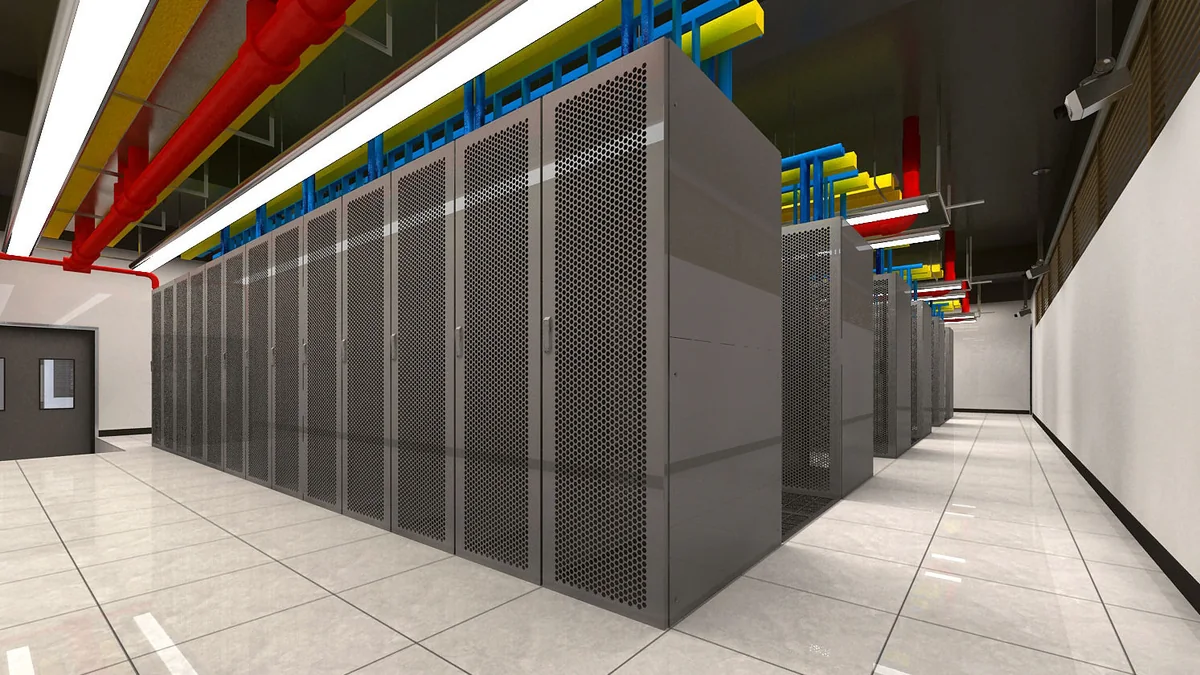
My answer: it stops being a warehouse and starts being a factory. On September 15, Huawei showed one extreme version of that in Wuhu. Its “3D data center” stacks four functions vertically instead of spreading them across a campus.
Cooling on one level. Compute on another. Power distribution on a third. Backup on a fourth. One building, 168 megawatts, with a 100,000-card Ascend cluster as the base configuration rather than the stretch goal.
The power wall arrived before the chip wall did
The shift starts with arithmetic. A 10,000-card AI cluster burns somewhere between 100 million and 130 million kilowatt-hours a year. At US industrial rates that is $8 million to $13 million annually, on a single building.
Electricity has become the largest single line in the operating budget of a high-density AI facility. Ahead of the people. Increasingly ahead of depreciation. The question quietly changed from whether you can buy the chips to whether you can afford to run them.
That is also why the physical layout has to change. A rack that used to draw a few kilowatts now draws 100 to 200. Same floor plate, ten to fifty times the power.
And the heat has to leave the room as fast as the electrons arrive. You cannot solve that by renting more land. You solve it by shortening every path the power and the coolant travel.
The scarce thing is not generation. It is interconnection. Ireland now sends 23% of all metered electricity to data centers, up 584% in a decade, and new projects there must bring their own generation or storage to get connected at all. Denmark paused new grid agreements in March with a queue near 60 gigawatts, roughly eight times its national peak.
The US is closer to that than it looks. PJM’s capacity auction cleared short of its own reliability requirement for the first time. The Department of Energy has three times this year used a 1935 emergency authority to push data centers onto diesel backup so the grid could hold.
So the constraint is a queue, not a shortage of dirt. That is worth saying plainly, because the popular version is that we are running out of electricity. We are not. We are running out of permission, transformers, and time.
Stacking the building is a way of paying the power bill
Which brings me back to Wuhu. The four-layer design borrows from how a semiconductor fab is organized. Separate the layer that moves power and fluids from the layer that does the work, then stack them so the distance between them collapses. Huawei says vertical zoning shortens the positive-side routing and cuts transmission loss.
It pairs that with prefabrication. More than 90% of the mechanical and electrical systems ship prebuilt. Electromechanical delivery drops from six months to three.
That trade is not free, and nobody at the launch dwelled on it. Stacking buys you speed and shorter cable runs. It costs you the thing a sprawling single-story hall gives away for nothing: room to work. Pulling a failed power module out of a third floor is a different job than wheeling it across a slab. Any design that optimizes for how fast you can energize a building has to pay somewhere else, and maintenance access is the usual currency.
That is not a compute breakthrough. It is a delivery breakthrough. And delivery is what is actually in short supply.
Huawei cannot buy the most advanced accelerators, so it moved its innovation one layer up the stack, from the chip to the room. Then it competed on how fast a building can be made to consume power productively. I think that is the most interesting engineering story of the year, and almost nobody outside China has written about it.
The company also opened its design library to the industry. Generous, until you recognize the pattern. Publishing reference designs is how you turn your architecture into the default, and Huawei ran exactly that play with 5G.
It is also a tell. An executive at the launch said plainly that opening the designs was a response to chip supply they cannot meet. Read that line twice. The stack is a workaround for a shortage.
Will the shape show up in Virginia? The form will. Multi-level, prefabricated, power-first designs are already being drawn everywhere the queue is long.
But the cause is different, and the difference matters. In China the pressure is chip supply plus centralized build-out. In the US it is interconnection queues, transformer lead times, and neighbors who do not want it.
That distinction is the reason I am skeptical of the simple version of this story. The same building shape gets built for opposite reasons. One country is stacking because it cannot get chips. The other would be stacking because it cannot get permits. If you only look at the renderings, you will mistake a shortcut for a strategy.
That last one is not a footnote. Gallup found in March that seven in ten Americans oppose data center construction in their community. Community opposition blocked or delayed at least 75 projects worth about $130 billion in the first three months of the year, and New York passed the country’s first statewide moratorium on new hyperscale facilities.
Here is where I think the story is actually heading. The breaking point is not the price increase. People absorb that badly. They still absorb it.
Residential electricity prices have risen more than 36% nationally since 2020. The move: 12.76 cents per kilowatt-hour to 17.44. And the Energy Information Administration expects another 5.1% in 2026.
The breaking point is stranded capacity. Sightline Climate estimates that up to half the data center capacity announced for 2026 may never get built. If that is even half right, utilities will have built transmission for customers who never showed up. Somebody still pays for it.
There is a real counterargument, and it deserves airtime. AI data centers can lower bills too. Fixed grid costs get spread across more customers. Three states saw load jump between 2019 and 2025.
North Dakota, New Mexico, and Nebraska were those three. Inflation-adjusted prices fell in every one of them. So the outcome depends on local capacity. Not on the mere presence of a data center.
And the fix is not where the press conference was. Brookings made the awkward point in July: federal pledges cannot settle this, because state utility commissions set the rates. Seven companies signed a ratepayer protection pledge at the White House in March. It binds exactly zero PUCs.
You can check your own exposure in about one minute. EPRI counts seven states heading past 20% by 2030. Oregon, Iowa, Nebraska, Nevada, Wyoming, Arizona, Indiana made that list. Anyone inside the PJM territory should read that list twice. After that, the question is not whether this reaches your bill.
Cost allocation sounds like a boring phrase. It decides everything. Utilities recover spending through rates approved by state commissions, and the split between a big industrial customer and a household is a policy choice. Not physics. That choice gets made in a hearing room most people never enter.
So my prediction, and it is falsifiable. Within two years the loudest fight here will not be about data centers raising your bill. It will be about data centers that were never built raising your bill. When a promised facility vanishes and the substation stays, the argument changes shape completely.
If you want one concrete thing to watch, skip the national numbers. Watch your state’s next rate case docket and the interconnection queue at your regional grid operator. That is where the decision gets made. It is also the only place a regular person can show up and be counted.