I am not here to debate whether AI-generated content should be labeled. That ship has sailed. The more interesting question, to me, is what happens when those labels get stitched into the fabric of code itself.
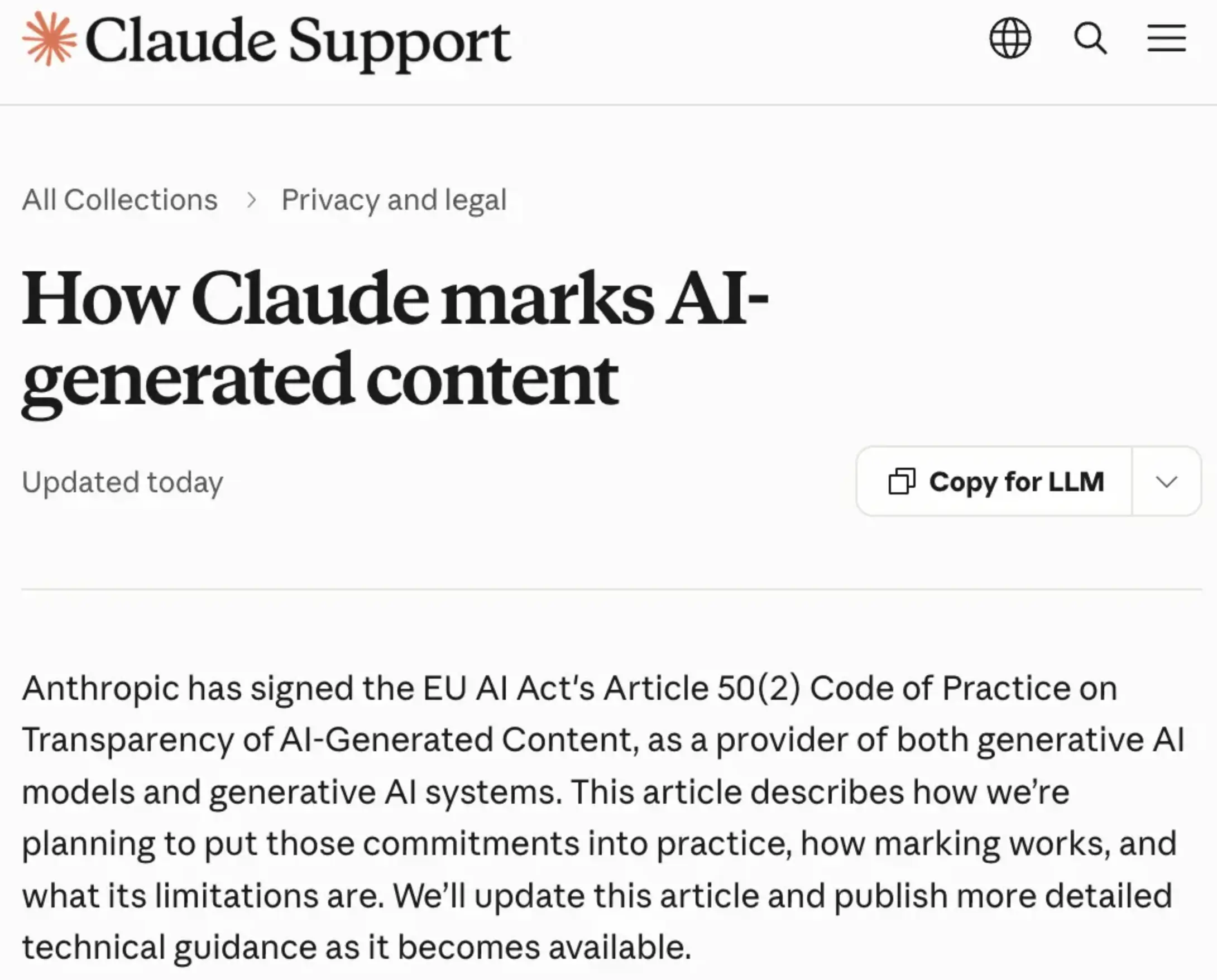
Anthropic just announced that starting August 2, 2026, all new Claude models will include built-in AI-generated content marking. Two techniques: a text-embedded watermark, and C2PA signature metadata for files. The coverage is global and full-scene, spanning the API, Claude, Claude Code, Claude Cowork, and Claude Tag.
I dug into the other half of this on its own, because what Anthropic’s detector can actually catch is not the same question as what gets marked in the first place.
The text watermark is invisible. It is woven into the text itself and travels with copy-paste. It supposedly does not affect meaning, quality, or readability. The file watermark follows C2PA standards and currently supports .svg, .png, and .jpg.
Notice what is missing from that list, though. Source files. The file-level watermark covers images only, which means for anyone writing code there is exactly one mechanism in play, the text one, and it is the one with the worse trade-offs.
Anthropic has not disclosed the exact algorithm. Community speculation points to something like Google’s SynthID, which works by subtly tweaking the probabilities of the next token rather than inserting obvious marker words. A classifier trained on Claude’s outputs would detect the pattern even though a human would not notice it. I went through how this kind of invisible watermark actually works when the first round of announcements landed, and the short version is that it is statistics, not secrets.
Some people have described it as a red-green token grouping scheme: you apply a slight bias to the next-token choice at each position, and the cumulative effect becomes statistically impossible to reproduce by chance. The principle is not complicated.
But the principle is not the problem.
The problem no one is talking about enough
Simon Willison put it best: if those code refactors are being seeded with some weird pattern just to act as a watermark, that is an absolute no-go. And akersten was even more direct: my code is going to be worse at random positions because of a watermark, and that is just to satisfy a voluntary EU recommendation.
That is the core conflict.
In prose, emails, or marketing copy, a watermark might be harmless. You are not optimizing every single token for precision. But in code generation, where every line needs to be exact, any interference with the probability distribution is a direct hit to output quality.
And it is worse than random positions, which is the part that bothers me most. A watermark can only bias the spots where the model genuinely has a choice. In code, most spots do not. After def foo( there is essentially one sensible continuation, and no amount of bias changes that.
The places where the model has real freedom are the ones you actually care about: naming, structure, which library to reach for, how to handle the edge case nobody remembered. So this does not degrade code evenly. It degrades the interesting parts, which are exactly the parts that determine whether the code is good.
I write code with Claude daily. Not just snippets, but full refactors, test suites, and config files. If the model is even 1 percent less accurate because it is choosing a suboptimal token to satisfy a watermarking scheme, that is not an academic concern. That is a bug I will have to debug at 2 a.m.
And here is what I have not seen anyone mention yet: code is read by machines as much as by humans. Watermarks embedded in generated code might not just make it harder to read. They might interfere with the tools that parse, lint, and analyze it, which would be a quiet tax on every pipeline that touches generated code.
What Anthropic themselves admit
The company’s own documentation lists a bunch of caveats. Detection does not mean absolute certainty. Absence of detection does not mean the content is not AI-generated. Heavy editing, rewriting, translation, or mixing with other content can degrade the watermark. Short passages do not provide enough signal.
So even if you wanted to rely on this for transparency, you cannot fully trust it. And if you cannot fully trust it, what is the point? A signal that means probably, sometimes is not a provenance system. It is a mood.
The bigger concern nobody is addressing
Dilettante_ on the forums raised a sharper point: Anthropic should explicitly acknowledge that text entirely written by a human could be misidentified as AI-generated. Too many institutions have the power to ruin someone’s life and have trouble grasping this concept.
That is the part that keeps me up at night.
We are building detection tools. Those tools have false positives. And false positives do not land on platforms. They land on people. A thesis that gets flagged. An article that gets pulled. Someone asked to prove they wrote something they did write, with no way to prove it.
Meanwhile aabhay made a subtle observation I cannot stop thinking about: Claude’s distinctive writing style is itself a fingerprint. Anthropic has deliberately reinforced how Claude writes, which makes its text more obviously AI-generated. That is more effective than a watermark, and much harder to evade, because it is baked into the model rather than layered on top.
A user’s decision
Stranded22 already made a choice: cancelled Claude Max 5x and switched to ChatGPT Pro. As someone with ADHD and dyslexia, they said they already have enough trouble making sure their meaning comes across correctly, and they do not want to work with a system that adds another layer of bias to their expression.
I get it.
My take
The watermarks are coming. The technology will improve. Detection tools will get built. But the hardest part is not the engineering. It is figuring out who is being protected, the users or the platforms.
Anthropic says this is about transparency. I do not doubt they believe that. But I also do not doubt that code quality will take a hit, that false positives will happen, and that some users will leave because the trade-off does not work for them.
For now, I am watching. I will keep using Claude for what it is good at. But I am not going to pretend this is not a trade-off, and if my code starts breaking in weird ways, I will let you know.