Google dropped Gemini 3.7 Flash on August 13. That’s three weeks after 3.6 Flash came out. Three weeks. I had to double-check that date the first time I saw it.
Here’s what actually matters: it’s better at coding, better with AI agents, and it costs half of what 3.6 Flash originally cost. That last part is the real headline.
Flash isn’t the Google AI tool I’d actually miss. That would be NotebookLM, which I use more than I ever expected to.
The coding improvements are real
I’m not a full-time developer, but I’ve used enough AI coding tools to know when something actually works. Google says 3.7 Flash is better at debugging, fixing issues, and generating code that’s ready to ship.
The numbers back it up. On FrontierCode 1.1 Main, 3.7 Flash scored 43.6% against 3.6 Flash’s 34.4%. On DeepSWE v1.1, it jumped from 49.0% to 65.3%. That’s a 16-point gain on a real-world coding benchmark, and those points tend to show up as fewer round trips between you and the model when you’re actually shipping.
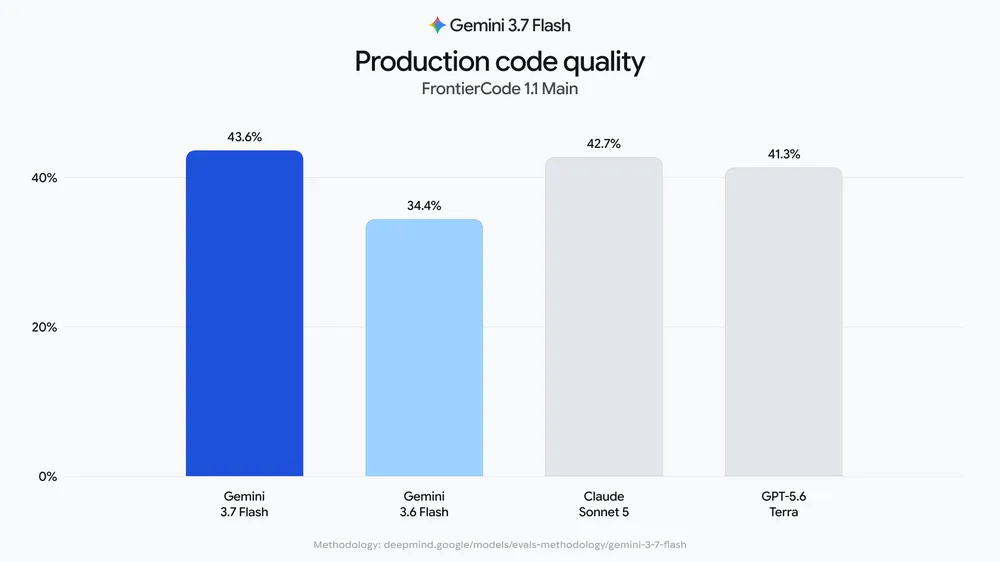
Wait, I should have said this earlier. These benchmarks test actual software engineering tasks, not trivia. FrontierCode checks whether the model can solve real programming problems. DeepSWE tests whether it can fix actual bugs in open-source projects. So these aren’t fake numbers that were tuned to look good in a press release.
Web development got a boost too. The model now scores 1588 Elo on WebDev Arena, up from 1538. In plain English, if you give it a screenshot of a website design, it’ll generate something that actually looks like the screenshot. Fewer prompts, fewer “close but not quite” results. The one caveat I’d add is that Elo scores move between snapshot runs, so treat the gap as directional rather than exact.
It’s not just for programmers
Google is positioning 3.7 Flash as a workhorse. It is something you can run all day for actual work. That means documents, not just code.
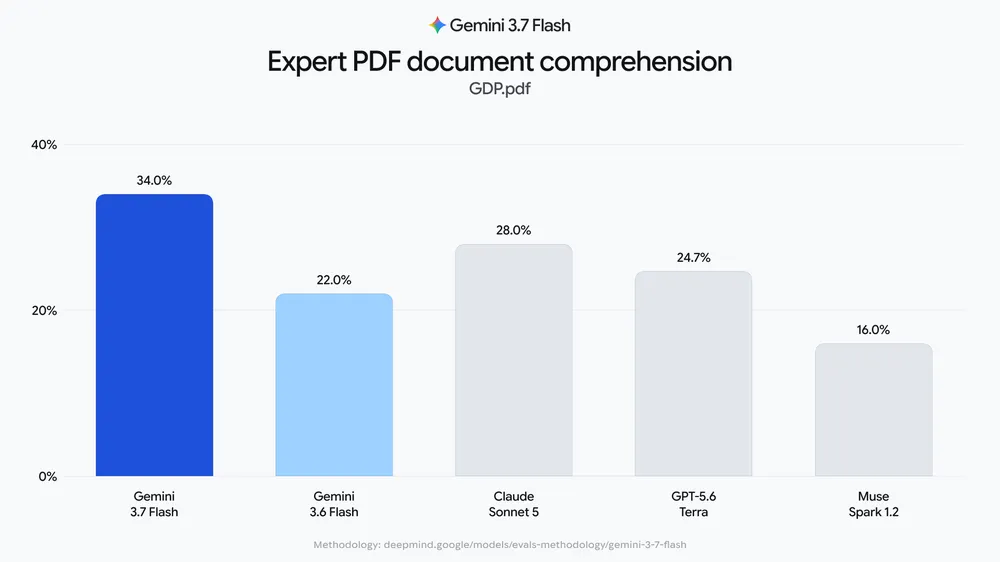
On the GDP.pdf benchmark, which tests how well a model handles complex documents like financial reports, 3.7 Flash scored 34.0% versus 22.0% for 3.6 Flash. On AutomationBench, which tests real business workflows, it went from 17.0% to 30.4%. Both are still low in absolute terms, so don’t expect it to replace a careful analyst, but the doubling matters for routine extraction work.
Google even showed a demo where 3.7 Flash turned a static annual financial report PDF into an interactive webpage with charts and analysis. That’s the kind of thing that actually saves people time, provided the source PDF is clean.
The price is the real story
This is where it gets interesting. Through the end of 2026, Gemini 3.7 Flash costs $0.75 per million input tokens and $3.75 per million output.
Half of what 3.6 Flash originally cost.
After December 31, it goes to $1.50 input and $7.50 output. So Google is running a half-off sale to get people to try it. Smart move, and a little unusual for a flagship-tier model line.
For context, most comparable models charge around $1.75 per million input tokens and $10.00 per million output. So even at full price, 3.7 Flash would be competitive. At half price, it’s a no-brainer for anyone building agents at scale.
Let me make that concrete, because “per million tokens” is a number nobody can feel. A task that burns 100,000 input tokens and 20,000 output tokens costs about 15 cents right now. The same task on January 1 costs 30 cents. Nothing on your side changes. Same prompt, same model, same output. The bill just doubles.
That’s the part I’d build around. If you’re prototyping, this window is genuinely cheap and worth using. If you’re writing a cost model for a product that launches next spring, don’t hardcode today’s price. The sale has an end date printed on it, and finance teams hate surprises more than they hate AI.
AI agents got a real upgrade
Google keeps talking about AI agents. These are systems that don’t just answer questions but actually do things. They read documents, call tools, write code, send emails, update project status.
Gemini 3.7 Flash is built for that. Google says it “better adapts to roadblocks, clarifies intent when needed, and follows instructions with greater fidelity.” It also puts more effort into multi-step planning and tool calls.
Translation: fewer times where the AI gets stuck and you have to step in. Fewer retries. Less babysitting.
And Google is already using it. Gemini Spark, their personal AI agent for Google AI Pro and Ultra subscribers, now runs on 3.7 Flash, which means it handles Gmail, Google Docs, and the other Workspace tools better than before.
Where can you use it?
Developers can reach it through the Gemini API, Google AI Studio, Android Studio, and Google Antigravity. Enterprise customers get it through Gemini Enterprise platforms.
Everyone else will mostly meet it through Gemini Spark, which is available to Google AI Pro and Ultra subscribers in over 160 countries. If you’re outside that subscription, you won’t touch 3.7 Flash directly, and that’s probably fine for most casual users.
My take
The three-week gap between 3.6 and 3.7 Flash tells me Google is moving fast. Really fast. They’re treating the Flash line as a testbed. Ship improvements quickly, collect feedback, iterate.
Meanwhile Gemini 3.5 Pro is still missing. Reports suggest it’s been delayed for months because the coding performance wasn’t good enough. So Google ships what works and takes its time on the flagship.
Is 3.7 Flash perfect? Probably not. A few benchmarks reportedly didn’t improve. CharXiv, which tests chart understanding, was slightly lower. And independent testing from Artificial Analysis gave 3.7 Flash a 56 on their intelligence index, just 4 points above 3.6 Flash. So the model quality barely moved. The price did the moving.
Which makes the price the actual product here, not the model. Google isn’t selling you a smarter Flash. They’re selling you roughly the same Flash for half the money, at a moment when almost everybody else is raising prices. I wrote about DeepSeek going the other direction a few weeks ago, and the contrast is the interesting part. One lab is discounting to grab volume, another is repricing to survive it.
I’m going to try it on a few projects this week. I’ll let you know how it performs in the real world. Benchmarks are one thing, and code that actually runs is another.
We’ll see.